ItsJustLight.com Rotating Header Image

Travel

Thomas Fogarty Winery

Thomas Fogarty Winery's Damiana Chardonnay Vineyard in Woodside, California

Most people spend a lifetime toiling away in one profession, often one they dont particularly enjoy. Few have the luxury of having a job they love, and even fewer still make any time to pursue their passions. Thomas Fogarty is a member of that rare breed of Rennaisance men, brilliant men (and women) who make careers of what they love and pursue all of their many talents and passions in life. The author or coauthor of more than 125 patents and patent applications, Dr. Thomas Fogarty is perhaps best known in the medical world for his Fogarty balloon embolectomy catheter. In plain English, the balloon embolectomy catheter has a small hollow tube with a tiny inflatable balloon attached at the tip. The catheter can be inserted into an incision in a blood vessel and pressed through the clot and inflated, displacing the blood clot. It sounds simple, but before Fogarty invented it as many as 50% of patients were dying on the operating table or losing limbs during surgery to remove blood clots. Dr. Thomas Fogarty invented the catheter even before recieving his MD from the University of Cincinnati, cobbling together his first prototypes with his fly tying skills developed as a young fisherman. His balloon embolectomy catheter became the very first minimally invasive surgical device and is the most widely used catheter for blood-clot removal today, responsible for saving the lives of over fifteen million patients.

In 1969 Dr. Thomas Fogarty began teaching surgery at Stanford University Medical Center and like many of us who move to California, it’s difficult not to become fascinated both by wine and winemaking. After helping a Stanford colleague with winemaking, Fogarty’s passion for the art grew and he purchased acreage in the Santa Cruz Mountains. Fast forward to the present, and the Thomas Fogarty Winery is a thriving estate, producing 15,000 cases of wine annually. With 325 acres (25 under vine) in Woodside, the Thomas Fogarty Winery estate is nestled in some of the most picturesque countryside in Northern California. We visited on a warm Wednesday afternoon and parked next to a duck and lily-pad filled lake adjacent to one of the vineyards planted with Chardonnay. A short walk up the driveway found us at the tasting room where as luck would have it, a four flight wine tasting is offered for free every Wednesday.

In addition to the large estate in Woodside, Dr. Thomas Fogarty also owns the Gist Ranch Estate, a 100 acre parcel 17 miles south of his Woodside winery. With 14 acres under vine there, several varieties of grapes are grown including Cabernet Sauvignon, Merlot, Malbec, Cabernet Franc, Syrah, Chardonnay and Pinot Gris.

Thomas Fogarty Winery - Damiana Chardonnay Vineyard


Thomas Fogarty Winery - Chardonnay grapes growing in the Damiana VineyardThe standout winner among the wines I sampled at Thomas Fogarty Winery was the 2006 Skyline Red, a Bordeaux style blend with 42% Cabernet Sauvignon, 39% Merlot, 10% Cabernet Franc, and 5% Petit Verdot. ’06 had one of the longest growing seasons in recent years and it shows in this medium weight red. It was a quiet day in the tasting room, with just two other couples there. The service was friendly and attentive and the tasting room was located on the second story of the building housing their production operation. From the balcony on the second floor, one can look down at the production room where there are large fermentation vessels and oak barrels.

The winemaker and viticulturist at Thomas Fogarty Winery is Michael Martella. Martella has been with the winery since it’s beginning in 1981, which says a great deal about both the skills of the winemaker and about Thomas Fogarty. A great many wineries hire an excellent winemaker when they first begin and of course go on to produce some outstanding wines. Then the winery begins to wonder why they are paying the winemaker so much money – after all, they’ve been watching him for a few years and they’re pretty sure they can do the same thing for a lot less money. The winemaker gets put out to pasture and it comes as little surprise that the wines begin to suffer. As it turns out, a skilled winemaker can be worth their weight in gold – and then some. That Fogarty has kept Michael Martella on as winemaker for three decades speaks volumes.

Thomas Fogarty Winery – Woodside, California. The tasting room can be seen in the upper left of the photo.

Chardonnay Grapes growing in the Damiana Vineyard at Thomas Fogarty Winery in Woodside, California

Thomas Fogarty Winery is located at: 19501 Skyline Blvd, Woodside, CA 94062. The tasting room is open Wednesday – Sunday from 11am-5pm. Enjoy!


Share

Camping & Photography at White Sands New Mexico

It’s been a while since the last update, but I’ve got a good excuse. I’ve been traveling and camping for the last two months. Have you ever tried to update a blog while you’re camping? Some folks seem to be able to do it, but I’m not one of them. It’s hard enough to find a place to take a shower out in the wilderness, and even harder to find a power plug so that I can charge my MacBook long enough to type something out. And then of course, you have the time for resizing all the photos I’ve been taking and then….IF (and it’s a big if) I managed to do all that while sitting in a (slightly leaky) tent in the rain in the middle of nowhere….I’d be stuck trying to find internet somewhere. Of course, there is always 3G internet, but contrary to what the TV ads all say about their great coverage, there are enormous areas of the United States where finding a signal of any sort (much less 3G) is about as unlikely as seeing Cher out mountain climbing. So, I didn’t even try. I know…it’s no excuse.

I briefly considered waiting until after the trip and then writing about every place I visited after the fact in chronological order, but now that I’m not camping any more, I want to write about what I’m doing now….not about how I was sleeping on a rock the month before. So, I’m stuck with a bunch of cool photos and awesome memories and experiences – but you might have to wait a while before they make their way to the blog – and when they do, it likely won’t be in chronological order. In any event, I’m in California now, where power plugs, showers, and granola are in abundance – so if I don’t start updating this thing more, I’ll have no excuse. Well, at least not any good ones.

Here’s a little tidbit from the trip.

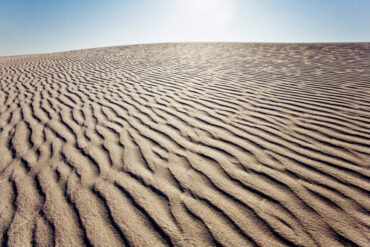
I took this photo at White Sands National Monument in New Mexico. There are 275 square miles of gypsum sand dunes to get lost in, and you could easily spend a few days exploring. We spent the night backcountry camping there, which was $3 per person. The site we camped at was about 3/4 of a mile from the parking area and trailhead. 3/4 of a mile is laughably easy on just about any terrain but sand, and as the name White Sands suggests….there’s a lot of sand here. It was quite a challenge getting to the top of some of those dunes carrying 50 pounds of gear and water. They recommend one gallon of water per person per day as a minimum and even though we only ended up drinking less than a gallon between two of us during the evening, it’s definitely better to struggle up a dune with a little too much water than to end up as a future archaeological exhibit.

There was only one other group camping in the backcountry and their site was far enough from ours that we couldn’t see or hear them, which is the way backcountry camping should be. Some people like the comforting sounds of screaming babies and generators humming at night, but I’d prefer to hear the wind. There were no fires allowed, so the propane stove probably added some unnecessary pounds to the pack – if I had to do it again, I think I would just forgo the cans of soup and just eat something cold. The temperature dropped at night into the 60s which was a great reprieve from the scorching daytime temperatures.

The sunset was beautiful and there was no worry about anyone else getting in the shots! The photo above was taken in the morning as we were hiking back toward the cars. The dunes are definitely more scenic the farther west you go from the parking area. They get larger and larger and the vegetation growing on them gets much more sparse, giving you the sense that you’re somewhere in the Sahara Desert. The photo was taken using a Canon 16-35mm f2.8 L lens, which really is a perfect lens to take to a place like this. I brought along a 300mm lens, but really didn’t use it at all. The wide angle the 16-35mm offers is perfect for showcasing the vastness of the dunes and the wide open expanse of blue sky above. A polarizing filter is a must have item for your kit too.

If you’re thinking of camping at White Sands National Monument, check out this Backcountry Camping Brochure. Campers have to register at the visitors center an hour or more before sunset, and with only 10 sites available it’s best to get there early in the peak season. You can fill your water bottles at the park visitors center, but there is no water available inside the dunefield once you go through the entrance, so be sure to bring a few jugs to fill up. Temperatures can fluctuate as much as 30-60 degrees from day to night, so if you visit during a cooler time of year, be prepared for it to get even colder at night. A good rule to remember is, bring extra clothing and extra water – the farthest site is only 1.1 miles from the trailhead, so carrying a few extra pounds trumps freezing during the night. It got chilly during our stay, but a lightweight backpacking sleeping bag plenty to keep me warm. If you’re backcountry camping at White Sands National Monument, you might not be able to get cell reception at your campsite so if you need to call someone, do it at the park entrance where there is definitely service. You could get a bar or two at the top of some dunes with AT&T.

There are rattlesnakes, black widows, and scorpions at White Sands, although the likelihood is that you will see none of these. Just don’t leave your shoes outside the tent and be sure to shake them out in the morning. Pay attention to where you are walking – several years ago I was jogging back to the car to grab my camera and nearly jogged right into a rattlesnake’s mouth.  Good thing they rattle! For photography here, a tripod or monopod would be nice to have along, but you can certainly take fantastic photos without it. If you are going to bring one, bring as light a tripod as you are able. Be sure to charge your camera batteries in advance since there are no power outlets near any of the trails. It might not hurt to bring along a little blower like the KOH Hepa Jet in case some dust finds its way into your camera – it can be pretty windy here, so if you are going to do a sensor cleaning, do it somewhere out of the wind.

Even if you aren’t planning on doing any primitive backcountry camping at White Sands National Monument, bring water with you even when hiking a short distance away from the road. If you lose sight of a reference point like a parking area, it can be very easy to get lost in the dune-field, and indeed several people do every year. Deaths in the park are rare, but as recently as June of this year a 23 year old woman died while hiking the Alkali Flats Trail, apparently of heat related causes. Temperatures during the day can soar to over 100F, so bring as much water as you can as well as high energy snacks. Have fun! I sure did.

See that little dot in the middle? That's the tent!


Share

A week in the wilderness

Living well is not just drinking fine wines, eating at Michelin starred restaurants, and mingling with the “it” people. Sometimes, to truly live well, you have to escape all of the pretensions of the big cities and take to the mountains. Great Smoky Mountains National Park is located within one day’s drive of half of the population of the United States, but during the week I visited, I had it almost entirely to myself.

This entry is a little belated (ok, it’s really a lot belated), but I’d rather share it with you now than not at all. This week took place in January, just before Snowmageddon blanketed the entire northeastern United States with a ridiculous amount of snow. I drove to the park from Atlanta, leaving on a Wednesday, early in the morning to avoid the reliably awful traffic that Atlanta is famous for. Around ten AM, I made a stop at Amicalola Falls State Park in northern Georgia. The park is gorgeous, and on the day I visited, nearly completely deserted. Amicalola Falls is an incredible 729 foot cascading waterfall, one of the tallest in the nation. The steep, one mile hike to the top of the falls was exhausting but well worth the effort. The temperature was in the low 30s and despite the sunny, cloudless weather, the icicles that had accumulated during the night were still thick and hanging like sparkling chandeliers from the branches overhanging the frothing water of the falls. It was an incredible sight, and definitely one that was nice to have entirely to myself without any tourists around. The view from the top of the falls was incredible, and the view from just below it even better. As I stood on the bridge that crossed the falls, railings and floorboards coated with ice, the roaring of the falls and the swirling clouds of chilled mist completely enveloped me.

(more…)

Share

High Museum of Art

High Museum of ArtOn a chilly February day I find myself in Atlanta visiting the High Museum of Art. Those who know me know that I love museums, in particular, museums that are as beautiful to look at as is the art within them. While far too many museums are simply drab concrete shells that do little to inspire, the High Museum is indeed architecturally beautiful.

On the day that I visited the High, the sky was obscured by low hanging fog that was pushed along by swiftly moving air currents, carrying a bitter chill and intermittent rain. Fortunately, the High is an incredibly large museum, offering ample room to escape the dreariness of winter lurking outside. Even on such a dark afternoon the museum was bright and well lit, owing largely to the incredible architecture that seemed to pull in every bit of light that the melancholy sky could muster.

The main building of the High Museum, built in 1983, was designed by Pritzker Prize winning architect Richard Meier. One of the greats of modern architecture, Meier has designed other iconic buildings including the Getty Center, New Harmony’s Atheneum, and the Jubilee Church in Rome. Like most of the structures Meier has designed, the High is white, the outside covered in porcelain-enameled steel panels. Over the two decades and change since then, much of the museum’s interior was changed – windows and skylights were covered up and interior walls were added. The problem was that there was simply too much light entering the museum for the sensitive artwork on the walls, in some cases 200 times too much. While all this light was bad news for the art, it was an amazing testament to just how effective daylight can be at providing illumination for large structures.

“Light, whether direct or filtered, admitted through skylights, ribbon glazing, clerestory strips, or minimal perforations in the panel wall, is a consistent preoccupation throughout; apart from its functional aspect, [light] is a symbol of the museum’s role as a place of aesthetic illumination and enlightened cultural values” – Richard Meier

The technology of the time simply was not what it is today, and much of the architectural intent was lost when skylights were covered up and interior walls added. In recent years however, the High was renovated to reverse many of the changes that had been made and to implement new technologies. Interior partitions that divided galleries were removed and high-tech window films were applied to the glass to filter out harmful ultraviolet light and control the amount of illumination that was allowed in.

In 2005, three new buildings at the High were opened to the public, doubling the size of the museum. The new buildings were designed by another Pritzker Prize winning architect, Renzo Piano. With 312,000 square feet, the High Museum is certainly worthy of the title “world class.” The permanent collections are impressive, the European collection perhaps the most so. My only disappointment after an enjoyable afternoon is that I don’t live in Atlanta; visiting this museum often would certainly be a pleasure.

High Museum

High Museum

High Museum

High Museum

High Museum

Share

Pocock Fine Art

Venice of America

Venice of America

Fort Lauderdale is known in the yachting world as the Venice of America – it’s home to more than 40,000 yachts and has an incredible 165 miles of waterways. Located only 23 miles north of Miami, the balmy weather is much the same, but the culture of Fort Lauderdale is quite different in many subtle ways. South Florida is known for its grand homes; properties change hands frequently and each new owner tends to build a monstrous home to their specs, only to have it torn down a few short years later and replaced with an even larger dwelling when a new owner comes along. With so much architectural rebirth and constant construction, the prevailing design aesthetic in South Florida is contemporary – new homes, new cars, new art. It’s understandable that the majority of galleries in the area cater to this demographic, but for my fellow collectors of fine art and antiques, it is fortunate that there remains a wonderful gallery that caters to the buyer looking for classic elegance.

Pocock Fine Art & Antiques is located on Las Olas Boulevard, a commercial stretch of restaurants, galleries, and shops that stretches east from downtown Fort Lauderdale towards A1A and the Atlantic Ocean. It’s a beautiful and refreshing location for a gallery devoted to fine art and antiques and in a city quite devoted to progress and the contemporary, it fills an important niche.

(more…)

Share